


ICSE vs CBSE vs State Board: Which Board is the Right Choice for Your Child?

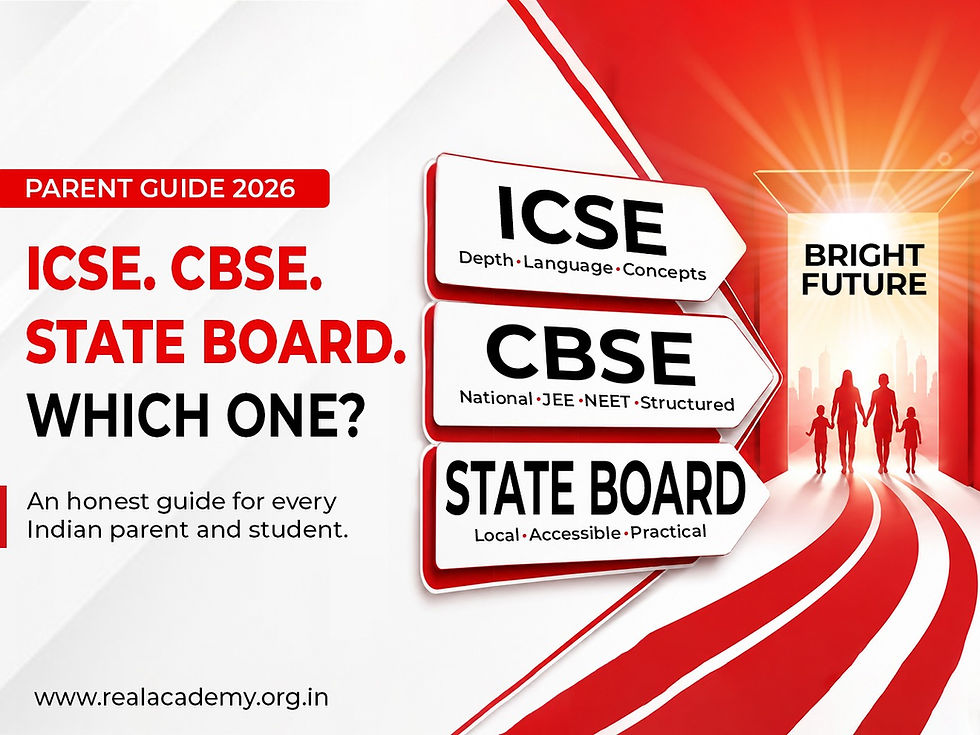
If you have been searching for a clear, honest answer to "ICSE vs CBSE vs State Board — which is best for my child?" — you have come to the right place. This guide does not take sides.
Every board has its own strengths, and the right choice genuinely depends on your child's personality, learning style, and future goals.
We will walk through each board simply and clearly, so by the end of this guide, you will know exactly which one makes sense for your family.
📋 In This Guide
A Quick Overview — What Each Board Actually Is
ICSE vs CBSE vs State Board — A Complete and Honest Comparison
Syllabus and Teaching Approach
Which Board is Better for JEE, NEET, and MHT-CET?
Which Type of Student Fits Which Board?
A Specific Note for Mumbai and Maharashtra Students
The Real Decision Framework — 5 Questions to Answer
3 Common Myths About Board Selection — Cleared
Frequently Asked Questions
Conclusion — Real Academy's Honest Guidance
A Quick Overview — What Each Board Actually Is
Before comparing, it helps to understand what each board was originally designed for. Each one has a genuine purpose and has produced excellent students for decades. None of them is universally better — they are simply different.


ICSE vs CBSE vs State Board — A Complete and Honest Comparison
Here is a side-by-side look at the areas that matter most to parents and students when choosing a board. Read through this table slowly — the differences are real and worth understanding before making a decision.
Area | ICSE | CBSE | State Board (Maharashtra) |
Governing Body | CISCE — Council for the Indian School Certificate Examinations | Central Board of Secondary Education | Maharashtra State Board of Secondary and Higher Secondary Education |
Curriculum Depth | Very detailed. More subjects. Broader coverage. | Structured and focused. NCERT-based. | Straightforward. Practical. Region-specific. |
English Emphasis | Very high. Literature and language both tested. | Moderate. Functional English focus. | Moderate. Regional language option available. |
Marking Pattern | Detailed internal marking. Subjective answers weighted. | Objective and subjective. MCQs included. | Mix of objective and subjective. Clear paper pattern. |
Transferability | Recognised globally and across India. | Recognised across all of India. Central board. | Strong within Maharashtra. Less portable nationally. |
JEE / NEET Alignment | Moderate. Concepts match but pattern differs. | High. NCERT is the base for JEE and NEET. | Moderate. Requires additional preparation. |
MHT-CET Alignment | Lower. Different syllabus base. | Moderate. Some overlap with MHT-CET. | Very high. HSC syllabus is the MHT-CET base. |
School Availability | Mostly urban, private schools. | Widespread — urban and semi-urban. | Most widespread. Available everywhere in Maharashtra. |
Fee Structure | Generally higher school fees. | Varies. Many affordable CBSE schools. | Generally most affordable. Wide range available. |
Best Suited For | Students strong in language and conceptual depth. | Students targeting national competitive exams. | Students targeting MHT-CET and Maharashtra institutions. |
Syllabus and Teaching Approach — What Your Child Will Actually Experience
How ICSE Teaches
ICSE encourages students to think, express, and analyse. The syllabus goes wider and deeper than most other boards. A Class 9 ICSE student covers more subjects and more detailed content than their counterparts in other boards. This breadth is genuinely useful for students who enjoy learning for the sake of understanding — not just to pass exams.
The English curriculum in ICSE is particularly strong. Literature, grammar, writing, and comprehension are all taught with seriousness. This produces students who communicate exceptionally well — a skill that benefits them throughout life regardless of career path.
One honest consideration — because the ICSE syllabus is broader, it can feel overwhelming for students who prefer clarity and focus. If your child finds the ICSE load heavy, it is not a reflection of their intelligence. It is simply a mismatch of style.
How CBSE Teaches
CBSE follows the NCERT curriculum — one of the most carefully designed educational frameworks in India. The content is structured logically, building from concept to concept in a clear sequence. Students know exactly what to expect and can prepare systematically.
CBSE's greatest strength is its national uniformity. A student who moves from Delhi to Mumbai stays in the same syllabus stream. Teachers across the country are trained in the same framework. And — critically — JEE and NEET are built around the NCERT curriculum, making CBSE students naturally more aligned with competitive exam preparation.
CBSE is also increasingly incorporating activity-based learning and internal assessment, reducing the pressure of a single final exam determining everything.
How Maharashtra State Board Teaches
The Maharashtra State Board has been serving millions of students across the state for decades. The curriculum is practical, accessible, and designed specifically for the Maharashtra student. Textbooks are available in Marathi and Hindi alongside English, which makes the content genuinely accessible to students from all backgrounds.
The HSC syllabus — Class 11 and 12 — is directly aligned with MHT-CET, Maharashtra's state engineering and medical entrance exam. This means state board students have a natural advantage when preparing for MHT-CET compared to students from other boards who need additional bridging.
The board is also by far the most widespread in the state — meaning coaching availability, peer networks, and teacher expertise are all strongest for state board students across Maharashtra's smaller cities and towns.

Which Board is Better for JEE, NEET, and MHT-CET?
This is the question most parents ask first — and honestly, it is a fair one. The board your child studies in directly affects how much additional preparation they need for competitive entrance exams. Here is the straightforward picture.
Exam | ICSE Alignment | CBSE Alignment | State Board Alignment |
JEE Mains | Moderate — bridging needed | High — NCERT aligned | Moderate — bridging needed |
JEE Advanced | Moderate — conceptual depth helps | High — NCERT is the base | Moderate — coaching essential |
NEET UG | Moderate — Biology depth is good | High — NCERT Biology aligns directly | Moderate — some topics differ |
MHT-CET | Lower — syllabus gap | Moderate — partial overlap | Very High — HSC syllabus is the base |
BITSAT | Good — broader syllabus helps | Good — NCERT aligned | Moderate — additional prep needed |
State CET / Local Exams | Moderate | Moderate | Very High — direct alignment |
What this table tells you — and what every experienced educator will confirm — is that no board gives you a free pass to any entrance exam. Every student, regardless of board, needs structured preparation to crack JEE, NEET, or MHT-CET. The board gives you a starting advantage in alignment — but good coaching and consistent effort are what actually determine results.

Which Type of Student Fits Which Board?
This is perhaps the most useful way to think about board selection — not which board is better in general, but which board suits your child's specific personality and strengths.
Consider ICSE If Your Child...
Is strong in English and enjoys reading and writing
Is naturally curious and enjoys learning in depth
Handles a heavier workload without becoming overwhelmed
Plans to study abroad or in globally recognised institutions
Is interested in humanities, literature, or liberal arts alongside Science
Attends or is considering a private urban school with strong ICSE faculty
Consider CBSE If Your Child...
Has a clear goal of cracking JEE or NEET
Prefers a structured, predictable curriculum
May need to relocate — CBSE schools are nationwide
Does well with systematic, step-by-step learning
Is in a family that may transfer cities due to work
Wants the NCERT foundation that most competitive exam coaching builds on
Consider State Board If Your Child...
Will study and build a career in Maharashtra
Is targeting MHT-CET for engineering or pharmacy
Is in a smaller city or town where state board schools are the primary option
Is more comfortable learning in Marathi or Hindi medium
Comes from a family that values accessible, practical education
Plans to appear for local competitive exams alongside HSC boards

A Specific Note for Mumbai and Maharashtra Students
If you are in Mumbai or anywhere in Maharashtra, there is additional context that is genuinely useful for your decision.
Maharashtra has a strong state board tradition. The SSC and HSC boards have been educating the state's students for generations. A significant majority of engineering, medical, and commerce professionals working across Maharashtra today are products of the state board system. This is not something to look down upon — it is evidence that the system works.
The MHT-CET — Maharashtra's engineering and pharmacy entrance exam — is based directly on the HSC syllabus. This means state board students in Class 11 and 12 are essentially preparing for their board exam and their competitive entrance simultaneously. This integrated preparation is a genuine advantage that students from other boards do not automatically get.
For students targeting premier national institutions through JEE or NEET — the board matters less than the preparation quality. Real Academy has students from ICSE, CBSE, and State Board backgrounds, all preparing for competitive exams. The coaching bridges any gap between what the board covered and what the exam requires.
One practical observation for Mumbai families — if your child is in an ICSE school and aims for MHT-CET, expect to put in additional effort in Class 11 to align with the HSC syllabus. This is manageable with the right guidance, but it is worth knowing in advance.
The Real Decision Framework — 5 Questions to Answer Before Choosing
Forget the arguments and opinions for a moment. Answer these five questions honestly — and the right board for your child will become much clearer.
Q1 What is your child's primary goal after Class 12?
Engineering via JEE → CBSE has an advantage. Medical via NEET → CBSE is strongly recommended. Engineering in Maharashtra via MHT-CET → State Board is the most practical path. Global studies or humanities → ICSE provides a strong foundation. Not yet decided → any board is fine, but keep flexibility in mind.
Q2 How does your child learn best — depth or structure?
If your child thrives when they understand the why behind every concept and enjoys going deep into subjects — ICSE may suit them well. If your child performs better with a clear, predictable structure and systematic revision — CBSE is likely a better fit. If your child is practical and responds well to application-based learning — State Board is worth considering.
Q3 How likely is your family to relocate before Class 12?
If there is any reasonable chance of moving to another city — CBSE makes the most practical sense. CBSE schools exist across every major city in India. ICSE schools are concentrated in urban areas, and State Board schools are largely Maharashtra-specific. Continuity matters enormously for a student's academic confidence.
Q4 What is the quality of the specific school — not just the board?
A great State Board school with experienced, caring faculty will produce better outcomes than a mediocre ICSE school with high fees and average teaching. Always visit the school. Speak to teachers. Ask to see recent board results. The board affiliation tells you the curriculum. The faculty tells you the actual learning experience.
Q5 What does your child actually want — have you asked them?
By Class 6 or 7, most children have a sense of what they enjoy — languages, numbers, science, arts. Their genuine interests are one of the best signals for board selection. A child who loves English and stories may thrive in ICSE. A child who loves solving maths problems and wants to be an engineer may find CBSE most energising. Their voice matters in this decision.
3 Common Myths About Board Selection — Cleared
Myth 1 — ICSE students are smarter than State Board students
This is one of the most unfair perceptions in Indian education. Intelligence has nothing to do with which board a child studies in. ICSE students cover more subjects and more detailed content — but that is a function of curriculum design, not student ability. The state board has produced millions of brilliant engineers, doctors, and leaders. The board is a syllabus framework. It does not measure intelligence.
Myth 2 — CBSE is the only way to crack JEE or NEET
This is not true. Every year, students from ICSE and State Board backgrounds crack JEE and NEET. The difference is that CBSE students have a syllabus head start because JEE and NEET are built around NCERT. Students from other boards need structured coaching to bridge that gap — but the gap is fully bridgeable with the right preparation. It is not a wall. It is a step.
Myth 3 — State Board is only for students who cannot get into ICSE or CBSE schools
This perception does a disservice to millions of students and families who choose State Board for entirely rational reasons. MHT-CET alignment, widespread school availability, language accessibility, and practical career preparation within Maharashtra are all legitimate and intelligent reasons to choose State Board. The board serves its purpose extremely well — and for many students in Maharashtra, it is genuinely the best choice.
Frequently Asked Questions
Which board is best for my child — ICSE, CBSE, or State Board?
There is no single best board for every child. The right board depends on your child's learning style, your family's situation, and your child's career goals. CBSE is generally recommended for students targeting JEE and NEET. State Board is most practical for students targeting MHT-CET and staying in Maharashtra. ICSE is well suited for students with a strong aptitude for language and conceptual depth. The decision framework in Section 7 of this guide will help you work through this clearly.
Can a State Board student crack JEE or NEET?
Absolutely yes. Students from Maharashtra State Board crack JEE and NEET every year. The HSC syllabus covers most of the core concepts required for both exams. The gap between the state board syllabus and JEE/NEET exam patterns is bridgeable with structured coaching that focuses on the specific chapters and question types that the board does not cover in the same depth as NCERT. With the right preparation starting in Class 11, state board students are very much competitive for both JEE and NEET.
Is ICSE better than CBSE for students going abroad?
ICSE is internationally recognised and its strong English curriculum does tend to be advantageous for students applying to universities in the UK, US, and other English-speaking countries. However, CBSE is also widely recognised globally. For students specifically aiming for international education, both boards are acceptable. The larger factors tend to be the student's academic performance, extracurricular profile, and language proficiency — not board affiliation alone.
What is the difference between SSC and HSC in Maharashtra State Board?
SSC stands for Secondary School Certificate — it is the Maharashtra State Board Class 10 examination. HSC stands for Higher Secondary Certificate — it is the Class 12 examination. Both are conducted by MSBSHSE (Maharashtra State Board of Secondary and Higher Secondary Education). When people say "state board" in Maharashtra, they typically refer to both SSC and HSC as a connected stream.
Which board should my child choose if they want to become a doctor?
For medical aspirants targeting NEET UG, CBSE is the most aligned choice because NEET is built around NCERT Biology, Chemistry, and Physics. However, students from ICSE and State Board backgrounds qualify for NEET regularly with structured coaching. If your child is already in State Board or ICSE, switching boards is not necessary — quality NEET preparation coaching that bridges the syllabus gap is the more practical solution.
Can I switch boards between Class 10 and Class 11?
Yes, it is possible and fairly common in India. Many students complete Class 10 from one board — say ICSE or State Board — and then join a CBSE school for Class 11 and 12, or vice versa. The transition requires some adjustment to the new syllabus structure, but it is manageable. If your child is making this switch, ensure they receive structured support in Class 11 to bridge any gaps between what they studied and what the new board expects.
Conclusion — Real Academy's Honest Guidance
Every Board Has Produced Brilliant Students. What Matters Next Is What You Do With It.
After 20 years of working with students from ICSE, CBSE, and Maharashtra State Board backgrounds, the Real Academy team can say this with confidence — the board is the beginning, not the destination.
We have seen ICSE students struggle in Class 11 and come out with 95% through structured support. We have seen CBSE students miss JEE and bounce back with MHT-CET. We have seen State Board students crack NEET and go on to careers in medicine that they love.
The board gives your child a curriculum to follow. What determines how far they go is the quality of teaching, the consistency of effort, and — crucially — the right guidance at the right time.
If you are at the point of making this decision for your child, the most important next step is not more research online. It is a genuine conversation with someone who understands both the board landscape and your child's specific situation.
That is exactly what our counsellors at Real Academy are here for. Come in for a free session. No pressure, no sales pitch — just an honest conversation about what makes sense for your child.


Comments